Georgia watering rules: the best Atlanta lawn schedule for 2027
Georgia allows lawn watering from 4 p.m. to 10 a.m. Start early, finish every zone by 10 a.m., split clay zones into short cycles, adjust by season.
Short answer: the best watering schedule for an Atlanta lawn in 2026 and 2027 starts with Georgia's watering rules. Under the Georgia Water Stewardship Act, anyone on a permitted public water system may water the landscape any day, but only between 4 p.m. and 10 a.m. Start early in the morning, let the last zone finish before 10 a.m., break clay-soil zones into short cycles with a soak between, and change run times as the seasons turn.
The rule, in plain words
Georgia EPD has enforced the same outdoor watering hours statewide since June 2, 2010. If your water comes from a city or county system, which covers most homes in intown Atlanta and the north metro, the hours are the same every day of the week: from 4 in the afternoon to 10 the next morning. A controller that is still running zones at 11 a.m. is outside the rule, even if nobody is standing in the yard.
These are the rules as of November 2026. A drought declaration can add stricter local limits, such as fewer days or shorter hours, and those can change within weeks. Your water provider's website or the number on your bill is the place to check before you set anything for the year.
What does not count against the window
| Exempt from the daily hours | Detail |
|---|---|
| Newly planted seed, sod and plants | Their first 30 days in the ground |
| Drip irrigation | Slow, low-volume watering at the roots |
| Soaker hoses | Treated the same as drip |
| Hand watering | Only with a hose nozzle that shuts off on its own |
| Personal food gardens | Vegetables and similar |
| Private wells | Not on a public system |
| Reuse water | Reclaimed or recycled supply |
That list comes from Georgia EPD and UGA Extension Circular C995. If you are not sure your yard qualifies, ask the provider rather than guessing.
In a drought year
When a drought response is declared, the limits that apply to your street come from that declaration and from your water provider, and they can cover days, hours and which exemptions still apply. We do not try to predict those orders, because they are set when they are needed and lifted the same way. Two habits keep you covered: read the notices from your water provider in a dry summer, and keep your controller programmed so that cutting a day or an hour is one change, made in a minute. The state's own page is Georgia EPD's water conservation guidance.
Water by the inch, then turn inches into minutes
The rule tells you when. The grass tells you how much. UGA Extension's Ten Steps to a Healthier Home Lawn (Circular 1009) says to apply enough water to wet the soil 6 to 8 inches deep, which is usually about 1 inch of water, or 600 gallons per 1,000 square feet. Rain counts toward that inch. A controller only knows minutes, so the useful step is learning how many minutes your own zones need to put down an inch.
The catch-can test takes about half an hour:
- Set out five or six straight-sided cans (tuna or soup cans work) across one zone, some near the heads and some in the middle.
- Run that zone for 15 minutes and turn it off.
- Measure the water in each can with a ruler and take the average.
- Do the math. Multiply the average by four to see what the zone puts down in an hour, then work out the minutes for an inch.
- Look at the spread. If one can is full and another nearly dry, that zone has a coverage problem, and more minutes will only flood the wet side.
Spray zones and rotor zones give very different answers, which is one more reason they belong on separate zones.
Grass by grass: what UGA Extension says
UGA Extension's bulletin Lawns in Georgia: Selection and Species (B1533-1) describes each lawn grass grown in the state. The weekly amount in the table is the general figure from Circular 1009, with rain included.
| Grass | When it grows | Water in its growing season | What UGA notes |
|---|---|---|---|
| Bermudagrass | Warm months, May to October; brown and dormant in winter | About 1 inch a week, rain included | Drought resistant, poor in shade, adapted to the whole state |
| Zoysiagrass | Warm months; dormant in winter | About 1 inch a week, rain included | Rated good for drought; does its best with 8 or more hours of sun |
| Tall fescue | Spring and fall; can stay green all year | About 1 inch a week, rain included | May need summer watering to stay green, and too much water leads to disease; best adapted to the Piedmont |
| Centipedegrass | Warm months | About 1 inch a week, rain included | Spring green-up can stall after a late cold snap |
| St. Augustinegrass | Warm months | About 1 inch a week, rain included | Cold sensitive, slow in spring after a hard winter; many lawns in the Atlanta area |
Two lessons come out of that table for intown yards. A shady fescue lawn and a sunny Bermuda strip on the same lot should not share a schedule. And a warm-season lawn that browns in winter is resting, so watering it in January to green it up only wastes water.
A month-by-month plan for 2027
This is how we plan a year for a typical Atlanta lawn. The inch figure is UGA's; the timing is our own planning from the seasons above.
| Months | Warm-season lawns (Bermuda, zoysia) | Tall fescue |
|---|---|---|
| January and February | System off and winterized | Off; hand water only in a long dry spell |
| March and April | Start up once freeze risk passes; light watering as it greens | Back to about an inch a week, rain included |
| May and June | About an inch a week, in two or three deep runs | Deep, less frequent runs as heat builds |
| July and August | Peak need; watch for drought stress signs | Enough to keep it alive; disease risk is high, so mornings only |
| September and October | Taper as nights cool | New seed gets short daily waterings while exempt |
| November and December | Winterize by early December | Winterize by early December |
Why early morning is the slot to use
The window opens at 4 p.m., but evening watering leaves grass wet overnight, and wet blades through a warm Georgia night are an open door for fungus. Circular 1009 agrees: it warns that late-afternoon watering can encourage disease and names the hours after dew forms and before sunrise as the most efficient time. For most yards we set the first program to start in the small hours so every zone wraps up with time to spare before 10 a.m.
Signs the lawn is short of water
Circular 1009 lists three signs of a thirsty lawn: a dull, bluish-green color, leaf blades that fold or roll, and footprints that stay visible for a minute or longer after you walk across it. UGA suggests watering once a third to half of the lawn shows them. If one zone always shows the signs first while the rest look fine, the cause is usually a clogged nozzle, a tilted head or a zone that runs too short, and adding minutes to every zone will not fix it.
Setting the controller, step by step
- Add up the minutes. Write down every zone and its run time, then total them. A yard with many zones can easily run past the cutoff if it starts too late.
- Work backward from 10 a.m. Pick a start time that leaves the whole program, plus a cushion, inside the window.
- Use cycle-and-soak on clay. Georgia clay takes water in slowly. One long run sends a lot of it down the curb. Split each lawn zone into two or three shorter starts with a pause between them, so the first pass soaks in before the next one lands.
- Keep rotors and spray heads apart. They put water down at very different rates, which is why they belong on separate zones.
- Set a different schedule for each grass. Bermuda, zoysia and fescue want different amounts at different times of year (we go through each one in why the grass decides the schedule).
- Check the clock after any power outage. A controller that lost its time can drift into midday without anyone noticing.
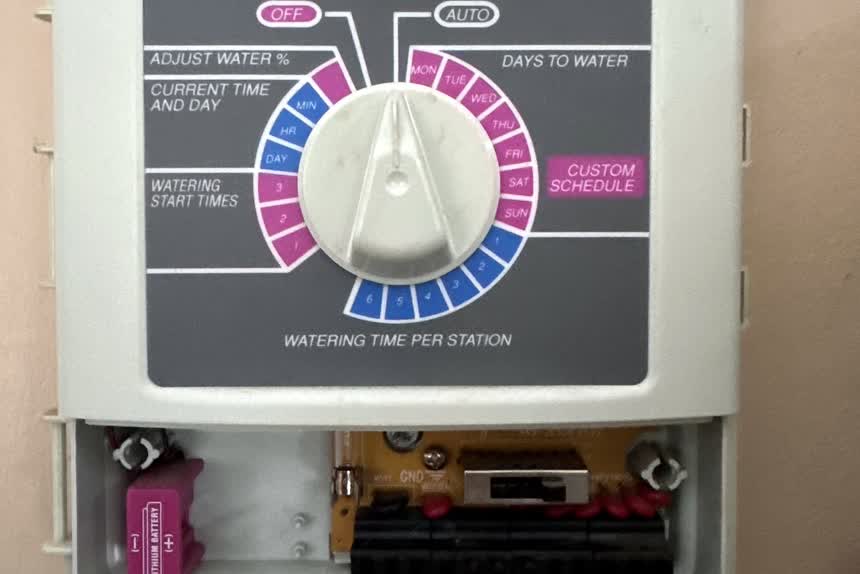
The photo shows the kind of dial controller we reset most often: start times, watering days and minutes per station each sit on their own setting, and all three matter for staying inside the window.
Changing it with the seasons
A schedule that is right in July is wrong in April. In spring, start light and add time as the lawn greens up. In the summer heat, the lawn needs the most water, and that is when a deep, less frequent schedule pays off most on clay. In fall, cut back as nights cool, and give new fescue seed the extra short waterings it needs while it is exempt for its first 30 days. By early December the system should be winterized and off, before the first hard freeze.
Where a smart controller helps
A smart Wi-Fi controller, installed from $575, adjusts run times to the weather, skips a run after rain and lets you shut a zone off from your phone. It makes staying inside the legal hours easier, though it is still worth looking at the start times once a season. A standard controller installed starts at $425, and a rain sensor installed starts at $425. Neither one is required by the rule (we compare the two in smart controller or standard timer).
When to call us
Call if you cannot read your controller's programs, if zones run in the middle of the day, if heads spray the driveway or the street, or if one corner of the lawn stays brown however long you water it. Our crew sets programs around the state hours as part of our irrigation service, and finds the cause of a dry or soggy zone rather than adding minutes. If a head or valve is the problem, our sprinkler repair starts at a $95 minimum service call. We serve intown Atlanta and the north metro, and estimates are free. Request a quote.
FAQ
What time can I water my lawn in Atlanta? On a public water system, any day from 4 p.m. until 10 a.m. For most lawns, the hours before sunrise work better than the evening.
What are the Georgia water restrictions for 2026 and 2027? The standing rule is the 4 p.m. to 10 a.m. daily window from the Georgia Water Stewardship Act. A drought declaration can add local limits, so check your water provider in a dry year.
What is the best time to water Bermuda grass? Before sunrise, inside the state window. UGA Extension names the hours after dew forms and before sunrise as the most efficient, and late-afternoon watering can encourage disease.
How much water does an Atlanta lawn need each week? About 1 inch during its growing season, rain included, according to UGA Extension Circular 1009. That is enough to wet the soil 6 to 8 inches deep.
Can I water new sod in the middle of the day? Yes, during its first 30 days in the ground, newly laid sod is outside the daily hours. A drought order can still limit that, so check your provider.
Does drip irrigation have to follow the 4 p.m. to 10 a.m. rule? No. Drip and soaker-hose irrigation are exempt from the daily hours.
How do I stop my sprinklers from flooding the street on clay? Split each lawn zone into shorter cycles with a soak between them, and keep rotors and spray heads on separate zones.
Should I water a brown Bermuda lawn in winter? Usually no. Bermuda goes brown and dormant in winter, and watering will not green it up. The system should be winterized by early December.
Sources: UGA Extension Circular C995, Circular 1009 (Ten Steps to a Healthier Home Lawn, reviewed July 2024) and Bulletin 1533-1 (Lawns in Georgia: Selection and Species), and the water conservation pages of Georgia EPD at epd.georgia.gov, checked November 2026. Prices from our price list. Updated November 2026.