Best ways to fix a soggy Atlanta yard in 2027
Start with the roof water, then the grade, then a catch basin or French drain. French drains start at $65 per linear foot in metro Atlanta.

Short answer: the best way to fix a soggy Atlanta yard in 2027 depends on where the water comes from. Roof water gets a downspout extension or a buried downspout. Water that slides toward the house needs the ground reshaped so it falls away. Water that collects in one low spot needs a catch basin, and water that crosses the yard needs a French drain, which starts at $65 per linear foot on our price list. Find the source first, then pick the fix.
Why so many Atlanta yards stay wet
Red Georgia clay is dense, and it takes water in slowly. Once the top few inches are soaked, extra rain either sits or runs off. Many intown lots were graded when the house went up decades ago, and soil settles, patios get added and neighbors regrade uphill. Winter makes it more obvious, because the ground stays cool, nothing dries quickly and long soaking rains come back to back.
Watch the water before you fix anything
Go out during a steady rain with a jacket and a flashlight. You are looking for three things: where the water enters the yard, where it travels and where it stops. A gutter overflowing at one corner, a stream crossing from the neighbor's lot and a puddle that forms at the same low spot every time each point to a different fix. Paying for a trench before anyone has watched this is how money ends up in the wrong place.
Three checks you can do before calling anyone
- Mark the edges. After a rain, push a few garden stakes or flags in at the edge of the wet area, then check them again the next day and the day after. A patch that shrinks steadily is slow clay. One that holds its size is fed from somewhere.
- Dig a test hole. With a post-hole digger, go down a little more than a foot in the wet spot and fill the hole with a hose. Look at it again the next morning. Water still sitting in the hole means the soil below is barely draining, and surface work alone will not dry that spot. Call 811 before you dig so buried utility lines get marked.
- Shut the water off. If the spot is wet in dry weather, turn the irrigation off at the controller for a few days. If the spot dries out, the cause is a leaking line or valve, and a repair costs far less than a drain.
Which fix fits your yard
Match what you saw in the rain to a row below. The last two columns say who usually does the work and where our price list starts, so the cheap fixes are easy to spot before anyone talks about trenches.
| What you see | Likely cause | Fix that usually fits | Who does it | Where our price starts |
|---|---|---|---|---|
| Water dumps beside the foundation at a downspout | Roof water with nowhere to go | Downspout extension or a buried downspout line | An extension is a homeowner job; a buried line is ours | Quoted after we see the run |
| A gutter overflows at one corner in heavy rain | Clogged or undersized gutter | Clean or fix the gutter first | Homeowner or a gutter crew | Outside our work |
| The ground slopes toward the house | Settled soil or old grading | Regrading so the soil falls away from the walls | Small areas by hand; bigger ones by a crew | Quoted after a site visit |
| One low spot holds water after every rain | A dip with no exit | A catch basin piped to a safe outlet | Us | Quoted with the pipe run |
| A wet strip runs across the lawn from uphill | Surface and shallow water from a higher lot | A French drain to intercept it | Us | French drains from $65 per linear foot |
| Water stands at the bottom of a slope or wall | Runoff from the whole hillside | A French drain or a basin at the toe of the slope | Us | French drains from $65 per linear foot |
| The ground stays wet for weeks, even in dry spells | A seep or high groundwater, or a leak | Rule out a leak, then a drain to collect the seep | Us, and sometimes a specialist | Repair visits start at our $95 minimum service call |
| The patch is wet when it has not rained | A sprinkler leak | Repair the line or valve before any drainage work | Us | Sprinkler repair from $95 |
More than one row can be true at once. A lot of wet yards need the roof water moved and one drain added.
Regrade or French drain: how to decide
Answer these in order, from what you saw in the rain:
- Does the water start on your lot, at the house or a downspout, and run toward the walls? Regrading, with the downspouts moved, is usually the right first step.
- Does the water arrive from uphill, from a neighbor's yard or a slope behind you? Regrading cannot stop it. A French drain across its path catches it.
- Is there a safe, lower place for the water to leave the lot? A French drain needs one. If there is none, the plan changes to a basin, a different outlet or a gentler grade, and that is a conversation to have before any digging.
- Is the wet ground right against the foundation? Start with the grade and the roof water, because a drain cannot make up for soil that pitches toward the house.
On cost, a small regrade by hand is often cheaper than a drain, while a large regrade with a machine and new sod can cost as much or more. We price regrading after a site visit, and French drains start at $65 per linear foot, so both numbers land on the same written quote when a yard needs both.
The fixes, from simplest to most involved
- Extend the downspouts. A splash block that drops water right at the wall is the cheapest problem to solve. A longer extension that carries water several feet out is a fine first step, and we walk through the choices in three fixes for downspouts at the foundation.
- Bury the downspout line. When an extension is in the way of the mower or the walk, the same water can travel underground to a pop-up emitter or another safe outlet.
- Reshape the grade. Sometimes a few inches of soil, moved to the right place and packed, turns water away from the house. This works when the slope is the whole problem, and it does nothing for water arriving from a neighbor's yard.
- Add a catch basin. A grate set at the low spot collects standing water and pipes it away.
- Put in a French drain. A gravel trench with a perforated pipe catches water moving through and across the yard, and gives it an exit. The outlet matters as much as the trench.
What a French drain costs
French drains start at $65 per linear foot. Length is decided by where the water starts and where it can leave the yard, so a few lengths help with the math. Our drainage page shows the starting price for three common runs.
- Example: a short run along one side of the house, 40 ft × $65 = $2,600 to start.
- Example: a run across the back lawn, 60 ft × $65 = $3,900 to start.
- Example: a long run from the high side of the lot to the street, 100 ft × $65 = $6,500 to start.
Those are starting figures only. The outlet, the restoration of the lawn or beds and what is buried in the way all affect the final number, and we explain each of those in what drives French drain cost in Atlanta. Your price is confirmed in writing before we dig. If we find something we could not see at the estimate, we stop and tell you before doing it.
What a drainage job looks like
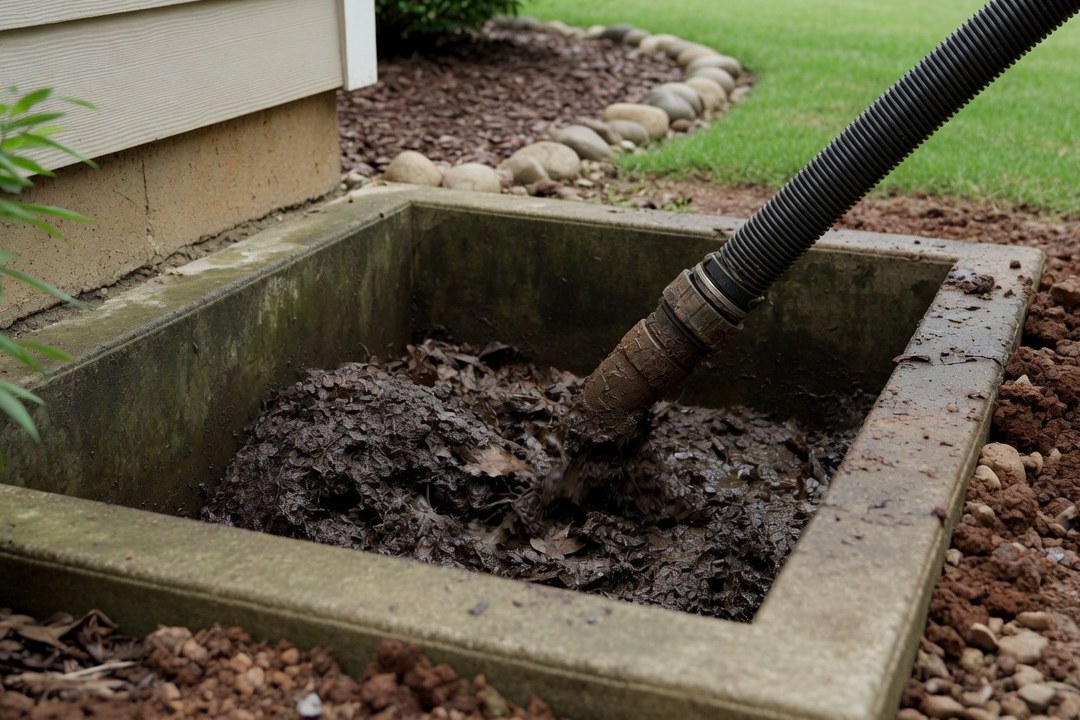
The photo is one of our drainage service visits: a drain box at the foundation, full of silt, being cleared so it can take water again. A catch basin or a French drain is only as good as its upkeep. Leaves, mulch and silt fill a grate over a season, and a blocked basin floods the very spot it was built to drain. That is why we come back to keep the basins clear rather than walking away after the install.
A typical French drain or basin job runs in this order:
- Walk the water. We look at where it enters, crosses and stops, and where it can leave the lot safely.
- Locate what is buried. Sprinkler lines, utilities and old drain pipe get marked before anyone digs.
- Set the grade. The pipe has to fall the whole way to the outlet, or it becomes a buried puddle.
- Dig, lay and backfill. Gravel, fabric where it fits the soil, perforated pipe for a French drain, solid pipe to carry basin water away.
- Restore the surface. Sod, mulch or stone goes back so the yard looks finished.
- Test it with a hose at the high end before the job is called done, then watch it in the next real rain.
Your neighbors, the street and the rules
Water that leaves your yard has to land somewhere. Sending it onto the lot next door moves the problem and can start a dispute, so we plan outlets that stay on your property or reach a spot that can take the water. If a plan calls for tying into a storm drain, a ditch or the street, ask your city or county first. Rules differ between the City of Atlanta, DeKalb, Fulton and the cities to the north, and we check them for the address before we design the outlet.
Mistakes that keep a yard wet
Piling topsoil around the foundation to soak up water only holds it against the wall. Pouring gravel into a low spot without an outlet makes a buried puddle. Each of these looks like a fix for a season.
When to call us
Call when water stands a day or more after an ordinary rain, when it reaches the foundation, crawlspace or garage, or when an extension or regrade did not solve it. We map where water already goes before we dig, and we come back to keep the basins clear. We are licensed and insured, our own crew does the work, and estimates are free. We serve intown Atlanta and the north metro. Request a quote.
FAQ
What is the cheapest way to fix a soggy yard? If roof water is the cause, extending or burying the downspouts usually costs far less than a drain. Watch the yard in the rain before choosing.
Will regrading fix my wet yard? It can, when the ground slopes toward the house. It will not stop water that arrives from uphill, which needs a drain to catch it.
How much does a French drain cost in Atlanta? On our price list, a French drain starts at $65 per linear foot. The length, the outlet and the restoration set the final price.
Is a wet spot a leak or a drainage problem? If it stays wet in dry weather, suspect the sprinkler system. If it only stays wet after rain, suspect drainage.
Catch basin or French drain: which one does my yard need? A catch basin suits water that pools in one low spot. A French drain suits water that moves across or through the yard. Many wet yards in Atlanta need one of each.
Do I need a permit for a French drain? It depends on the city or county and on where the water goes. Ask before tying into a storm drain, a ditch or the street; we check the rules for the address before we design the outlet.
Can I put in a French drain myself? A short run with a clear downhill outlet is a reasonable project for a handy homeowner. Long runs, flat lots and yards with sprinkler lines in the way are where the grade and the outlet tend to go wrong.
Why does my yard stay soggy all winter? Georgia clay drains slowly, and cool weather means little dries out between rains. A spot that holds water for days after every winter storm usually needs an outlet, not more soil.
Prices from our price list; the worked lengths are starting math at that price, not quotes. Call 811 (Georgia 811) before digging. Updated November 2026.