Best month-by-month sprinkler and drainage calendar for Atlanta yards in 2027
A month-by-month plan for Atlanta sprinklers and drainage in 2027: start up after the freeze risk, water by the state rule, winterize by early December.
Short answer: the best month-by-month plan for an Atlanta yard in 2027 is simple. Use January and February to check drainage during the winter rains and plan any new work. Start the sprinklers up once the freeze risk has passed, usually in late March or April. Water through the summer within the state's evening-to-morning hours, give fall seed its extra waterings, and winterize by early December, ahead of the first hard freeze.
The two dates that frame the year
Both come from the National Weather Service office in Peachtree City. In its yearly table for the Atlanta airport station, covering 1948 to 2020, the last spring freeze came in March in 50 of the 73 years, in April in 16 and in February in 7. In 57 of those years it was over by April 1, and in every year by April 23, the latest one on the list, in 1986 (weather.gov/ffc/atlgroseason, read November 28, 2026). For the fall side, the same office gives Atlanta's average first freeze as November 13, with the earliest on October 11, 1906 and the latest on December 18, 1998.
So a sprinkler system has a safe run from spring into the fall, with risky edges at both ends. The calendar below is built around those edges.
| Freeze fact (NWS Peachtree City, Atlanta airport) | Date or count |
|---|---|
| Last spring freeze over by April 1 | 57 of 73 years, 1948 to 2020 |
| Last spring freeze fell in April | 16 of 73 years |
| Latest last spring freeze on that list | April 23, 1986 |
| Average first fall freeze | November 13 |
| Earliest first fall freeze on record | October 11, 1906 |
| Latest first fall freeze on record | December 18, 1998 |
Add the year to your phone
We put the key dates from this page into a calendar file you can load into the calendar on your phone or computer: download the 2027 Atlanta yard calendar (.ics). It holds twelve all-day reminders, from the January drainage walk to winterizing by early December, each with a one-line note on what to do and a link back to this page. It has no appointments in it and asks nothing of you; delete any reminder you do not want.
The calendar at a glance
| Month | Sprinklers | Drainage |
|---|---|---|
| January | System stays off and drained | Walk the yard in a heavy rain, mark wet spots |
| February | Plan any new zones or repairs | Good month to fix drains before spring storms |
| March | Start up only after a freeze-free stretch; reset the controller clock | Clear grates and downspout outlets |
| April | Start-up for most yards; check the backflow device and rain sensor, set spring times | Watch where spring storms send water |
| May | Add time as warm-season grass greens | Check that new beds did not block a drain path |
| June to August | Early-morning runs inside the state window | Look for runoff and standing water after storms |
| September | Short extra waterings for new fescue seed | Note any spot that stayed wet all summer |
| October | Cut run times as nights cool, book winterization | Keep leaves off basins and grates |
| November | Winterize, protect the backflow device | Clear leaves again after they finish falling |
| December | Done by early December, system off | Watch the first long winter rains |
January and February: drainage season
The system should be off and winterized. This is the time to learn your yard's drainage, because long, cold rains show every weak spot. Note where water stands a day after an ordinary rain, where it reaches the foundation and where it crosses the lawn. Cool months are also a calm time to install a French drain, before spring growth and storms. French drains start at $65 per linear foot, and our drainage service maps where the water already goes before we dig.
March and April: start-up, carefully
A warm week in early March is tempting, but the table above shows freezes into April in some years. We turn systems back on once the forecast has settled, and we look at the backflow device before the first watering (the full timing walk-through is in when to turn the sprinklers back on). A spring start-up visit costs $175–$225. It covers charging the system, walking every zone and setting the controller for the season.
The spring checks, month by month
A start-up is several small jobs, and they fit the months differently:
- Early March: the controller. Confirm it has power, set the date and clock, and replace the backup battery if it takes one. Last year's start times are often still set from the summer.
- March: the rain sensor. Clear the leaves and pollen off it and make sure it moves. A stuck sensor either blocks every run or never stops one.
- Late March or April: the backflow device. Check it before the first watering for cracks, drips and rust, since winter is hard on it. Backflow repair and installation start from $800, and we also test and certify these devices if your water provider asks for a test.
- April: the first full run. Open the main valve slowly and walk every zone while it runs.
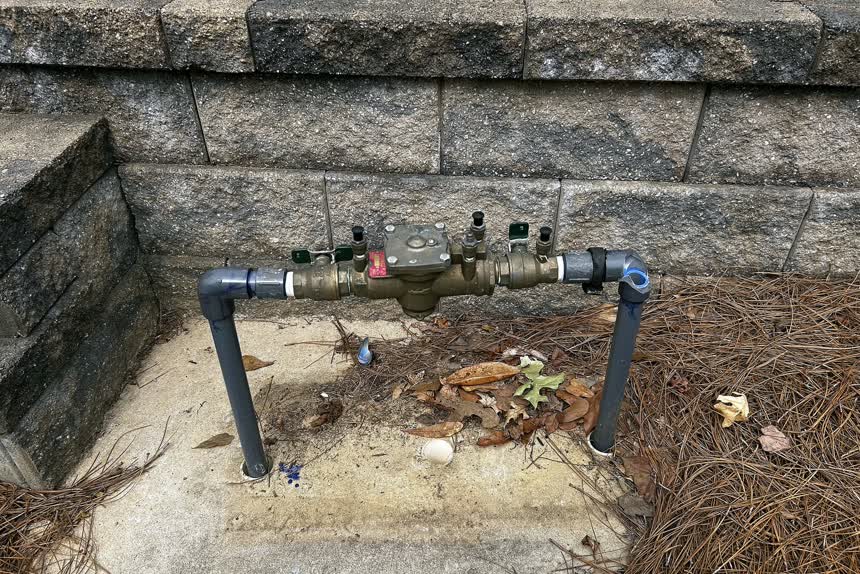
The backflow preventer in the photo, from one of our jobs, sits above ground on its riser, open to the cold air, which is why a hard freeze is so hard on it.
May through August: water by the rule
From May the lawn needs more water each week. Georgia's Water Stewardship Act, in force statewide since June 2, 2010, lets homes on a public water system water the landscape every day, as long as it happens after 4 p.m. or before 10 a.m. We aim for the hours before sunrise. On clay, split long zones into shorter cycles with a soak between them so water sinks in rather than running down the curb. Drought declarations can add local limits, so check your water provider in a dry summer. If a zone fails in the heat, we can often be out the same day.
September and October: seed and cut back
Fall is fescue overseeding time. New seed is exempt from the daily hours for 30 days after planting, and it wants short, frequent waterings that keep the top of the soil damp. Once the seed is up, taper back to the normal schedule. As nights cool through October, shorten run times. Keep leaves off catch basin grates, because a blocked grate floods the spot it was built to drain.
November and December: winterize before the freeze
The average first freeze arrives in mid-November, so book winterization before then if you can. We blow every line out and protect the backflow device, and winterization costs $95–$120. Our rule for both sprinkler systems and backflow devices is to be finished by early December, before the first hard freeze (more on that timing in when to winterize sprinklers in Atlanta). After that, the system stays off until spring.
After winterizing: leave it off
Once the lines are blown out, the system should not run again until spring, even on a warm December afternoon. A single run puts water back into pipes and heads that are meant to sit empty, and the next hard freeze can split them. If you need to water a few shrubs during a dry winter week, use a hose and put it away afterward. Through the winter, glance at the backflow device after a cold snap. A cracked body, a split fitting or ice on the device means a call in spring before the first watering.
A printable checklist for the year
If you prefer paper, print this page or copy the list below to the fridge.
- January: walk the yard during a steady rain and mark the wet spots.
- February: plan drainage fixes and any new zones.
- March: reset the controller clock, clean the rain sensor, clear grates and downspout outlets.
- Late March or April: freeze-free forecast, then start-up, backflow check and a walk of every zone.
- May: add run time as warm-season grass greens up.
- June to August: early-morning runs, finished by 10 a.m.; look for runoff after storms.
- September: short daily waterings for new fescue seed.
- October: shorten run times, book winterization, keep leaves off the grates.
- November: winterize ahead of the November 13 average first freeze if you can.
- December: done by early December, system off, grates clear.
When to call us
Call for a spring start-up or a winterization visit, for a zone that will not come on, or for a yard that stays wet after rain. We are licensed and insured, our own crew does every visit, and estimates are free. Our irrigation service covers start-ups, winterization and controller setup across intown Atlanta and the north metro. Request a quote.
FAQ
When should I turn my sprinklers on in Atlanta? Once the freeze risk has passed. In the National Weather Service table for 1948 to 2020, the last freeze was over by April 1 in most years and by April 23 in all of them.
When should I winterize my sprinklers in Atlanta? By early December, before the first hard freeze. Atlanta's average first freeze is November 13, according to the National Weather Service.
What is the last frost date in Atlanta for 2027? No one can name the exact date ahead of time. In the National Weather Service table for the Atlanta airport, the last spring freeze was over by April 1 in 57 of 73 years, and the latest one on the list came on April 23.
When is the best time to fix yard drainage in Atlanta? January and February work well. The winter rains show where water goes, and the work is done before spring storms.
What does a year of sprinkler service cost? A spring start-up is $175–$225 and a fall winterization is $95–$120 on our price list. Repairs are separate.
Can I run my sprinklers in November? Only until the system is winterized. Once the lines are blown out, leave the system off until spring, even in a warm spell.
When should the backflow device be checked? Before the first spring watering, and after any hard freeze. We repair, install, test and certify backflow devices.
How often should catch basins be cleared? Check the grates in March and again in October and November, when leaves fall. A blocked grate floods the spot it was built to drain.
Freeze dates from the National Weather Service, Peachtree City office (weather.gov/ffc/atlgroseason and weather.gov/ffc/cold, read November 28, 2026). Watering rule from Georgia EPD. Prices from our price list. Updated November 2026.