Backyard ideas for Atlanta yards in 2027, and the water work each one needs
Eight backyard ideas for 2027 and what to settle underground first: runoff, sprinkler lines, drip, sleeves and wire, before anything is built.
Short answer: most backyard ideas for 2027 change where water lands in an Atlanta yard. A patio sheds rain, new beds want drip in place of spray, fresh sod needs its own watering and a play lawn needs even coverage. Settle the water work underground first: drainage, sprinkler lines, sleeves under paving and wire runs. Then build. It costs far less than cutting into finished work.
Why the water comes first
Georgia clay takes in water slowly, so anything that changes a yard's surface changes where the rain goes. A new patio or raised bed can send water toward the house or leave it sitting in the lawn. Sprinkler lines and drain pipe also run under the spots people want to pave or plant, so doing that work first keeps you from paying twice.
What we build, and what we work beside
We do the water, light and sound work in a yard: sprinkler lines and drip, drainage, low-voltage lighting and outdoor audio. The patio, deck, wall or planting itself comes from your hardscape or landscape crew. The ideas below are written from our side of that line, so each one says what has to be settled underground before the other crew arrives.
Eight backyard ideas, and what each one needs underground
| Idea for 2027 | What to settle first | Where our prices start |
|---|---|---|
| A new patio or paver walk | Where its runoff will go, and sleeves under it for pipe and wire | French drains from $65/linear ft |
| Bigger planting beds in place of lawn | Drip lines for the beds, and capping the old spray heads | Quoted after we walk the beds |
| A lawn refresh with new sod or seed | Even head coverage, and a schedule for the first weeks | Sprinkler repair from $95 |
| An open play lawn | Heads moved to the edges so nothing sticks up in the middle | Sprinkler repair from $95 |
| A smarter watering setup | A controller that skips runs in wet weather | Smart Wi-Fi controller from $575 |
| Fixing the soggy corner for good | Where the water starts and where it can safely leave | French drains from $65/linear ft |
| Evenings outside with path lights or music | Wire runs that share the trench with irrigation | Lighting from $195/fixture, audio quoted on estimate |
| Beds in place of thin grass under big trees | Drip in place of lawn spray, and a zone of its own | Quoted after we walk the beds |
A patio or paver walk
Pavement sheds nearly all the rain that hits it. Before the base goes down, decide which way the patio will slope and where the edge water will go, whether that is a catch basin, a French drain or a planted strip that can take it. Lay a sleeve (a length of empty pipe) under the paving so future sprinkler lines or wire can pass under it without lifting stones. We go deeper on this in planning drainage with a new patio.
Bigger beds, smaller lawn
Trading some turf for shrubs and perennials is a common plan. Spray heads built for grass throw water onto mulch, paths and leaves. Drip lines put water at the roots, and Georgia EPD lists drip irrigation among the methods exempt from the state's daily watering hours (epd.georgia.gov). Plan the drip zone with the bed layout, and cap any spray heads that will end up buried under the new planting.
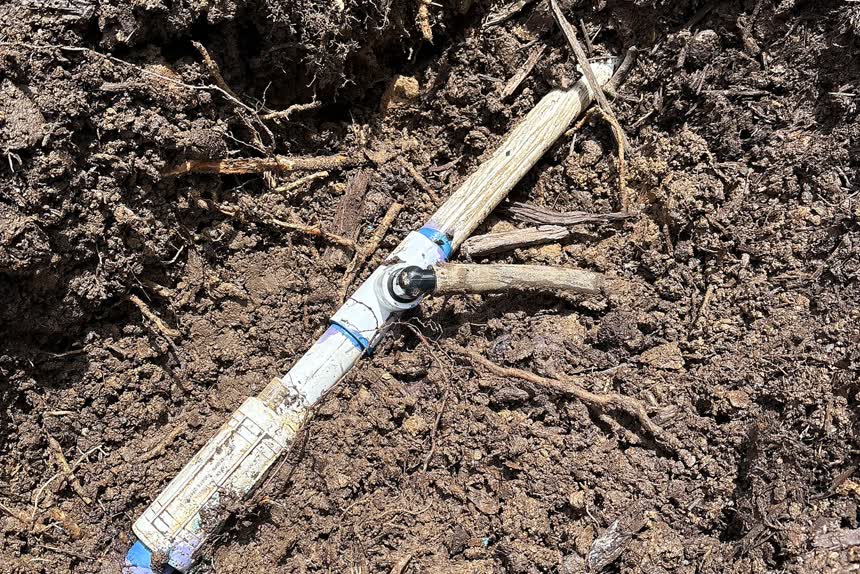
The photo is from one of our jobs: a sprinkler line and fitting uncovered in a bed. Lines like this one run through most planted areas, and a bed redesign that does not know where they are tends to find them with a spade.
A lawn refresh with sod or seed
New turf needs frequent, short waterings for its first weeks, and Georgia EPD exempts newly installed sod, seed and plants from the watering hours for 30 days after planting. Before the sod arrives, run every zone and fix tilted heads, since a dry stripe in new sod shows fast. After those 30 days the regular rule is back: if your home is on a permitted public water system, you can water any day, but only from 4 p.m. until 10 a.m. the next morning.
Beds under the big trees
Intown Atlanta lots often have mature oaks and maples that shade much of the back yard. UGA Extension's bulletin Lawns in Georgia: Selection and Species (B1533-1) says bermudagrass performs poorly in shade, while tall fescue grows in full sun or moderate shade and some zoysia cultivars hold up with four to four and a half hours of filtered sun. Where even those thin out, a shade bed with drip is often a better idea than another round of seed. The water side is simple: the old lawn heads in that area come out or get capped, the bed gets its own drip zone, and trenching stays shallow and careful around the roots.
An open play lawn
Kids, dogs and a game of catch all run into heads in the middle of the grass. A layout that waters from the edges inward keeps the open area clear. It can mean moving heads and changing nozzles, so it is easiest while the yard is already open for another project.
A smarter watering setup
A smart Wi-Fi controller runs from $575 and a standard one from $425 on our list. The smart one adjusts for the weather, which suits a yard whose plantings are changing. A rain sensor, installed from $425, stops a run during a storm. Pick it once the new zones are known.
Fixing the soggy corner for good
A spot that stays wet after every rain usually has one source: a downspout, a slope from next door or a low area with nowhere to drain. Building a bed or patio on top will not fix it. Watch the water during a steady rain, mark where it starts and stops, and fix the drainage before the new project covers it (our walk-through of the choices is in ways to fix a soggy yard). French drains start at $65 per linear foot.
Evenings outside
Path lights and hidden speakers both need low-voltage wire in the ground. Planned with the irrigation, that wire shares the trench: one dig, one round of lawn repair. Landscape lighting starts at $195 per fixture on our price list, and outdoor audio is quoted on estimate.
Questions to settle with your patio or landscape crew
Before work starts, these answers should be written down and shared between the crews:
- Which way will the new surface drain, and where does that water go once it leaves the edge?
- Where are the sprinkler lines and valves now? We can flag them before anyone digs.
- Which heads will end up under paving, mulch or new beds, and who caps or moves them?
- Where do sleeves go under paving for future pipe and wire?
- Will the new grade send water toward the house or a neighbor's yard?
- Who restores the lawn where trenches cross it, and when?
Small intown lots and larger north metro yards
On a small intown lot, every idea competes for the same small patch of ground, and side yards are often the only path for pipe and wire. Planning the trench routes first keeps them from crossing the patio. On a larger lot in the north metro, the challenge is distance and grade: long runs from the water supply, slopes that send runoff a long way, and zones that need splitting so the low end does not stay soggy. Either way, the same order applies.
The order that saves money
- Fix the drainage so the new work is not sitting in water.
- Lay sleeves under any patio, walk or driveway work.
- Move or add sprinkler lines, including drip for new beds.
- Run wire for lights or speakers in the same trenches.
- Plant and lay sod, then set the controller for the new zones.
When to call us
Call before the patio crew or the sod delivery shows up. We map where water already goes before we dig, our own crew does the work, and estimates are free. We are licensed and insured and serve intown Atlanta and the north metro. See irrigation installation, drainage or request a quote.
FAQ
What should I plan first for a backyard project? Plan the drainage and the sprinkler lines first. Water work happens underground, and it is cheaper before the patio and plants go in.
Do I need to change my sprinklers if I add planting beds? Usually yes. Spray heads made for lawn waste water on beds, so drip lines are a better fit for new planting areas.
Can I water new sod outside Georgia's watering hours? Yes, for 30 days after planting, according to Georgia EPD. After that, water only between 4 p.m. and 10 a.m.
Can lighting wire go in the same trench as irrigation? Yes. Planning lights or speakers with the irrigation lets the wire share the dig.
Will a new patio break my sprinkler lines? It can, if the lines run under the patio area and nobody marks them. We flag the lines and valves first, and move them or lay sleeves before the base goes down.
Is drip irrigation a good choice for Atlanta beds? Yes, for most shrub and perennial beds. It puts water at the roots, and Georgia EPD exempts drip from the daily watering hours.
Should irrigation go in before or after new sod? Before. Run and adjust every zone first, then lay the sod, so no one has to cut into new turf to fix a head.
What grows under big shade trees in Atlanta? UGA Extension says bermudagrass does poorly in shade, while tall fescue and some zoysias handle moderate or filtered shade. Where grass keeps thinning, a shade bed with drip often works better.
Prices from our price list. Watering window and the drip and new-planting exemptions from Georgia EPD's water conservation guidance (epd.georgia.gov) and UGA Extension Circular C995. Shade notes from UGA Extension Bulletin 1533-1. Updated November 2026.