Bermuda, zoysia or fescue: your grass sets the schedule, not the calendar
Most over-watering in metro Atlanta comes from running a schedule built for a different species of grass. Work out which one you have and half the argument disappears.
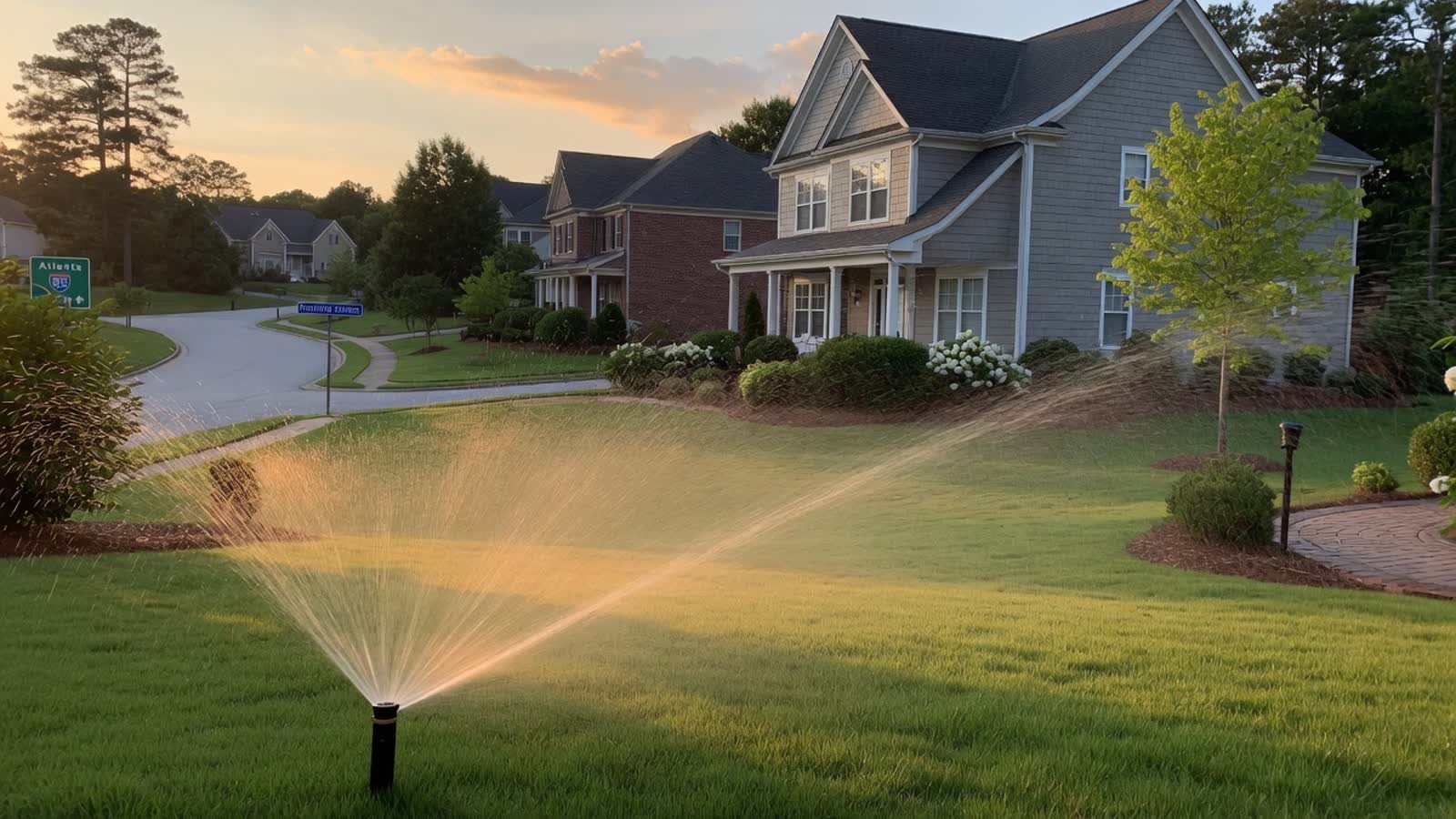
Two houses on the same street, the same controller, the same run times — one lawn is thriving and one is thin and diseased. Usually the difference is not the system. It is that the two lawns are different grasses with opposite needs, on a schedule that was set for whichever one the installer had in mind.
Telling them apart without a lab
- Bermuda — fine blades, spreads aggressively by runners above and below ground, loves full sun, goes completely brown and dormant in winter and comes back. If your lawn creeps into the beds and the driveway cracks, it is Bermuda.
- Zoysia — denser and softer underfoot, blades a little wider, forms a thick carpet that resists weeds, tolerates some shade, also goes dormant brown. Feels like a rug; slow to fill in when damaged.
- Fescue — coarse blades growing in clumps rather than running, stays green through winter, hates August. If your lawn looks its best in November and its worst in July, it is fescue.
Why that changes the watering
Bermuda and zoysia are warm-season grasses. They do their growing in the heat, root deep, and want infrequent, deep watering — enough to wet the soil several inches down, then nothing until they need it again. Watering them lightly every day trains the roots to stay shallow, which is exactly what you do not want in a Georgia August.
Fescue is a cool-season grass surviving in a climate that is wrong for it. It has a shallower root system and no dormancy strategy for heat, so through summer it needs more frequent water just to hold on, and it is far more prone to fungus when leaves stay wet. Same yard, opposite instructions.
The cycle-and-soak problem, which is really a clay problem
Red Georgia clay accepts water slowly. Run a zone for twenty-five minutes straight and a good part of that water leaves as runoff before it ever soaks in — you have paid for it, the meter counted it, and the root zone never saw it.
The fix is to split the same total time into shorter bursts with a gap between them: three ten-minute cycles an hour apart instead of one thirty-minute run. Each burst goes in; the gap lets it move down through the clay. On any controller made in the last fifteen years this is a built-in feature, usually called cycle and soak or multiple start times.
Two things worth measuring yourself
How much water a zone actually puts down. Set six or eight straight-sided cans — tuna cans are perfect — around a zone, run it fifteen minutes, then measure the depth in each with a ruler. The average tells you the zone's rate; the spread between the fullest and the emptiest tells you whether the zone is even. A zone that is fine on average and wildly uneven can never be fixed with run time, only with heads and spacing.
Whether the water is reaching root depth. An hour after a cycle, push a long screwdriver into the lawn. If it goes in easily to four or six inches, you are wetting the root zone. If it stops at an inch, you are watering the surface, whatever the controller says.
Both take ten minutes and neither needs us. If the cans come back uneven, that is a design conversation — how we approach zoning is on the irrigation page.